
Strong pelvic floor muscles can make your orgasms 40% more intense and help you reach them faster.
You've heard kegel exercises help with pleasure, but you're not sure if you're doing them correctly or feeling results.
Section 01Why Your Pelvic Floor Matters for Pleasure
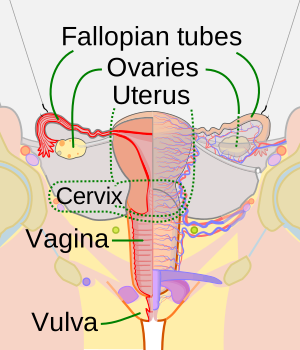
Your pelvic floor muscles wrap around your clitoris, vagina, and anus like a supportive hammock. When these muscles are strong and responsive, they create more intense sensation during arousal and help your body build to orgasm more easily. Think of them as your pleasure amplifiers.
Weak pelvic floor muscles can make it harder to feel sensation during penetration and may cause that frustrating feeling where you get close to orgasm but can't quite get there. Some women who do regular kegel exercises report stronger, more consistent orgasms within weeks of starting a routine, though individual results vary.
Section 02Finding Your Pelvic Floor Muscles
The easiest way to locate your exercises/" class="contextual-link">pelvic floor is to imagine stopping your urine mid-stream. The muscles you engage to do this are your pelvic floor. You can also insert a clean finger into your vagina and gently squeeze - you should feel pressure around your finger.
Another technique: lie on your back and imagine drawing your belly button toward your spine while lifting your pelvic area up and in. You should feel a gentle lifting sensation rather than bearing down or pushing out.
A reliable self-check is to insert one clean finger about an inch into the vagina and squeeze. You should feel a gentle inward lift and grip around your finger — not a bearing-down pressure. If you feel your abdomen bulge outward or your buttocks tighten, you are recruiting the wrong muscle groups. Repeat this check periodically as you build strength; the feedback from your own body is more accurate than any visual cue.
The Connection Test
Place one hand on your chest and one on your lower belly. When you engage your pelvic floor correctly, your breathing stays normal and your belly doesn't push out. If your chest rises or your belly bulges, you're using the wrong muscles.
Section 03Basic Kegel Technique
Proper kegel exercises involve both squeezing and releasing your pelvic floor muscles. The release phase is just as important as the contraction - it teaches your muscles to relax completely, which is crucial for comfortable positions/" class="contextual-link">penetration and orgasm.
Start with short holds and work up to longer ones. Your pelvic floor muscles fatigue quickly at first, so don't expect to hold long contractions immediately. Consistency matters more than intensity when you're building strength.
Section 04Advanced Techniques for Better Results
Once you master basic kegel exercises women can add variations like elevator kegels, where you gradually increase the squeeze intensity in stages, then slowly release in the same stages. This builds more precise muscle control.
Pulse kegels involve quick, light contractions that improve muscle responsiveness. These are particularly helpful for enhancing sensation during oral sex or when using a vibrator on your clitoris.
Section 05How Kegels Improve Your Sex Life
Stronger exercises/" class="contextual-link">pelvic floor muscles increase blood flow to your genital area, making you more sensitive to touch. They also help you feel internal pressure and movement more intensely during positions/" class="contextual-link">penetration, whether from fingers, toys, or a partner.
Many women notice they can build arousal faster and feel their partner more distinctly during sex. The improved muscle control also means you can consciously squeeze during penetration, creating extra sensation for both you and your partner.
Section 06Positions That Make Kegels More Effective
Gravity changes how much load your exercises/" class="contextual-link">pelvic floor carries, and you can use that to your advantage. Lying on your back with knees bent removes gravitational resistance, making it the easiest starting position for beginners identifying the correct muscles. Once the movement feels automatic there, shift to seated — sitting upright on a firm chair increases the challenge slightly because your bodyweight presses down through the pelvis. Standing is the hardest variation and the most functional, since it mimics the demands placed on the pelvic floor during daily movement and sex.
A bridge position adds a useful layer: lie on your back, raise your hips off the floor, and perform slow holds at the top of the lift. The glutes are engaged but should not be doing the squeezing work — keep them relaxed enough that you could slide a piece of paper between your cheeks. This isolation teaches you to fire the pelvic floor independently of surrounding muscle groups, which translates directly to stronger, more deliberate contractions during partnered sex.
Stop if you feel pain
Kegel exercises should never hurt. If you experience pelvic pain, stop the exercises and consult a healthcare provider. Some women have overly tight pelvic floor muscles that need relaxation techniques instead.
Step-by-stepPractical Instructions
Find a comfortable position
Lie on your back with knees bent and feet flat, or sit in a chair with your feet on the floor. Keep your back straight but relaxed. Place one hand on your chest and one on your belly to monitor your breathing stays normal throughout the exercise.
Locate your pelvic floor
Gently contract the muscles you would use to stop urinating mid-stream. You should feel a lifting sensation in your pelvic area. Avoid tensing your buttocks, thighs, or abdominal muscles. Your breathing should remain steady and your belly shouldn't push out.
Contract and hold
Squeeze your pelvic floor muscles and hold for 3 seconds. Focus on lifting the muscles up and in, not bearing down. Keep breathing normally - don't hold your breath. The contraction should feel controlled and deliberate, not strained.
Release completely
Let your muscles relax fully for 3 seconds between contractions. This rest phase is crucial - your muscles need to return to their normal resting position. You should feel a clear difference between contracted and relaxed states.
Repeat the cycle
Perform 10 repetitions of the contract-hold-release cycle. Do this routine 3 times per day. As your muscles get stronger over 2-3 weeks, gradually increase your hold time to 5, then 10 seconds, with equal rest periods between contractions.
Progress to functional positions
Once you can easily do kegel exercises women lying down, practice them sitting, standing, and walking. This builds strength in positions you'll actually use during sex. Try doing quick pulses during daily activities like brushing teeth.
Avoid theseCommon Mistakes
Holding your breath during contractions
Creates unnecessary tension and reduces blood flow to the area
Squeezing buttocks or thigh muscles
Works the wrong muscles and can cause back pain
Bearing down instead of lifting up
Weakens your pelvic floor over time and feels uncomfortable
Doing too many repetitions initially
Causes muscle fatigue and soreness that discourages consistency
Skipping the relaxation phase
Creates tight muscles that interfere with arousal and orgasm
"Women with stronger pelvic floor muscles report significantly more intense orgasms and better sexual satisfaction overall."
Study of 300 women over 12 weeks of pelvic floor training
FAQFrequently Asked Questions
Further ReadingRecommended Books
- Come As You Are — Emily Nagoski The science of female sexuality
- She Comes First — Ian Kerner A guide to clitoral stimulation
Links are affiliate links. We may earn a commission at no extra cost to you.
SourcesPeer-reviewed references
- Nazarpour S, Simbar M, Ramezani Tehrani F, Majd HA (2017) Effects of sex education and Kegel exercises on women's sexual function: a randomized clinical trial. Journal of Sexual Medicine. doi:10.1016/j.jsxm.2017.02.002
- Piassarolli VP, Hardy E, Andrade NF, Ferreira NO, Osis MJ (2010) Training the pelvic floor muscles to treat stress urinary incontinence. Brazilian Journal of Urology. doi:10.1590/S1677-55382010000400008
- Lowenstein L, Gruenwald I, Gartman I, Vardi Y (2010) Can stronger pelvic muscle floor improve sexual function?. International Urogynecology Journal. doi:10.1007/s00192-009-1077-5
Every DOI above resolves via CrossRef. Figures quoted in this article are drawn from these papers or stated in qualified terms.
