
Kegels alone won't give you the strong pelvic floor you need for better orgasms.
You've been doing squeeze-and-release exercises for months but still feel weak during sex or can't reach climax.
Section 01Why Most Pelvic Floor Exercise Routines Fail
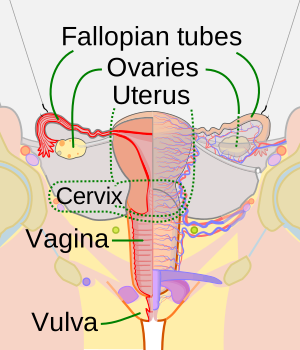
Your pelvic floor isn't just one muscle you can squeeze. It's a complex group of muscles, ligaments, and tissues that work together to support your bladder, uterus, and rectum. When you only do basic Kegels, you're training just one small part of this system.
Think of it like trying to get strong abs by only doing crunches. You might feel a burn, but you're missing the deep stabilizer muscles that actually create core strength. The same happens with pelvic floor exercises women typically learn - they target the superficial muscles but ignore the deeper layers that control arousal and orgasm intensity.
Section 02The Three Muscle Layers That Control Your Pleasure
Your pelvic floor has three distinct layers, and each one plays a different role in sexual response. The superficial layer includes the muscles around your vaginal opening that contract during orgasm. The middle layer supports your urethra and helps with arousal. The deep layer stabilizes your entire pelvis and creates the foundation for intense sensations.
When all three layers work together, you get stronger orgasms, better muscle control during sex, and improved sensitivity. Most women only train the superficial layer through basic exercises-women/" class="contextual-link">Kegel exercises, which is why their results plateau after a few weeks.
The Deep Layer Connection
The deepest pelvic floor muscles connect directly to your diaphragm and core. When you breathe correctly during these exercises, you activate this connection and create full-body muscle coordination that translates to more powerful orgasms.
Section 03How Strong Pelvic Floor Muscles Improve Orgasms
Strong pelvic floor muscles don't just prevent incontinence - they directly affect your ability to reach climax and how intense your orgasms feel. These muscles control blood flow to your genital area, support the internal structure of your clitoris, and create the rhythmic contractions you feel during orgasm.
When your pelvic floor is weak, blood flow decreases and you lose sensitivity. When it's too tight, you can't relax enough for arousal to build. The right pelvic floor exercises women need create a balance - muscles that can contract powerfully and relax completely.
Section 04Beyond Kegels: What Actually Works
Effective pelvic floor training combines strength, flexibility, and coordination exercises. You need movements that challenge these muscles in different positions, not just lying on your back squeezing. Real functional strength comes from training your pelvic floor to work with your whole body during movement.
The exercises in this guide target all three muscle layers through dynamic movements, breathing patterns, and position changes. You'll train your pelvic floor the way you actually use it - integrated with your core, coordinated with your breath, and responsive to different types of stimulation.
Section 05Creating Your Personal Exercise Routine
Your ideal pelvic floor routine depends on your current strength level and specific goals. If you've never had an orgasm, you need exercises that improve blood flow and muscle coordination. If you can climax alone but not with a partner, focus on exercises that build endurance and control.
Start with 10-15 minutes three times per week. You should feel muscle fatigue but never pain. Most women notice improved sensation within 2 weeks and significant strength gains within 6-8 weeks of consistent practice.
When to Seek Professional Help
If you experience pain during these exercises or have persistent pelvic floor dysfunction, consult a pelvic floor physical therapist. Some conditions require manual therapy or specialized treatment that exercises alone cannot address.
Step-by-stepPractical Instructions
Master the Connection Breath
Lie on your back with knees bent. Place one hand on your chest, one on your belly. Inhale slowly, letting your belly rise while gently allowing your pelvic floor to expand downward. Exhale, drawing your belly button toward your spine while lifting your pelvic floor up and in. Feel the connection between your breath and your pelvic floor movement.
Practice Deep Layer Activation
From the same position, breathe normally while focusing on the deepest pelvic floor muscles near your tailbone. Instead of squeezing, think about gently lifting this area toward the top of your head. Hold for 5 seconds, then completely relax for 10 seconds. The movement should feel subtle and deep, not like a strong squeeze.
Add Dynamic Bridge Exercises
Lie on your back, feet flat on floor. Exhale as you lift your hips into a bridge while gently engaging your pelvic floor. Hold for 3 seconds, feeling the connection between your glutes, core, and pelvic floor. Lower slowly on an inhale, releasing the pelvic floor. Repeat 10-15 times, focusing on smooth coordination between movement and muscle activation.
Train Functional Squats
Stand with feet hip-width apart. As you lower into a squat, inhale and allow your pelvic floor to gently expand. As you stand up, exhale while lifting your pelvic floor. This teaches your muscles to work during real movement patterns. Start with 8-10 squats, building to 15-20 as you get stronger.
Practice Quick Contractions
In any comfortable position, perform rapid pelvic floor lifts - 1 second contraction, 1 second release, for 30 seconds total. This trains the fast-twitch muscle fibers responsible for orgasmic contractions. Rest for 60 seconds, then repeat 2-3 times. Quality matters more than speed.
Master the Release
Sit comfortably and contract your pelvic floor to about 50% of maximum effort. Hold for 10 seconds, then focus completely on releasing and relaxing these muscles for 20 seconds. Many women struggle more with relaxation than contraction, but both are essential for sexual response and pleasure.
Build Coordination Patterns
Stand and march in place, lifting your knees toward your chest. On each knee lift, engage your pelvic floor. As you lower your leg, release the muscles. This teaches your pelvic floor to respond automatically during movement and helps build the mind-muscle connection you need during sex.
Test Your Progress
Lie down and insert a clean finger about 2 inches into your vagina. Contract your pelvic floor and feel for lifting and tightening around your finger. You should feel distinct pressure from multiple directions, not just top to bottom. This gives you real feedback about your muscle control and strength gains.
Avoid theseCommon Mistakes
Holding your breath during exercises
Breath holding creates tension and prevents proper muscle activation
Squeezing buttocks and thighs
Using wrong muscles compensates for weak pelvic floor and prevents progress
Doing only strength exercises
Tight muscles can't relax for arousal and may cause pain during sex
Expecting immediate results
Muscle changes take time and inconsistent practice prevents adaptation
Exercising through pain
Pain indicates dysfunction that exercise alone may not fix
"The pelvic floor works as part of your core system, not in isolation. Training it functionally with breath and movement creates better sexual outcomes than isolated contractions."
Study on pelvic floor exercise effectiveness
FAQFrequently Asked Questions
Further ReadingRecommended Books
- Come As You Are — Emily Nagoski The science of female sexuality
- She Comes First — Ian Kerner A guide to clitoral stimulation
Links are affiliate links. We may earn a commission at no extra cost to you.
SourcesPeer-reviewed references
- Bø, K., & Nygaard, I. E (2020) Is physical activity good or bad for the female pelvic floor? A narrative review. Sports Medicine. doi:10.1007/s40279-019-01243-1
- Lowenstein, L., Gamble, T., Sanses, T. V., van Raalte, H., Carberry, C., Jakus, S., & Kenton, K (2010) Sexual function is related to body image perception in women with pelvic organ prolapse. Journal of Sexual Medicine. doi:10.1111/j.1743-6109.2010.01820.x
- Ellsworth, P., & Caldamone, A (2008) The role of pelvic floor muscle exercises in the treatment of female urinary incontinence. Current Opinion in Obstetrics and Gynecology. doi:10.1097/GCO.0b013e32830ce7c7
- Shishido, K., Peng, Q., Jones, R., Omata, S., & Constantinou, C. E (2008) Influence of pelvic floor muscle contraction on the profile of vaginal closure pressure in continent and stress urinary incontinent women. Journal of Urology. doi:10.1016/j.juro.2008.05.020
- Sigurdardottir, T., Steingrimsdottir, T., Geirsson, R. T., & Halldorsson, T. I (2020) Can postpartum pelvic floor muscle training reduce urinary and anal incontinence?: An assessor-blinded randomized controlled trial. American Journal of Obstetrics and Gynecology. doi:10.1016/j.ajog.2019.12.281
Every DOI above resolves via CrossRef. Figures quoted in this article are drawn from these papers or stated in qualified terms.
