
Taking Sexy Back promises to transform your relationship with yourself and your partner through self-awareness.
You're tired of relationship advice that feels disconnected from your actual sexual and emotional needs.
Section 01What Taking Sexy Back Actually Covers
Alexandra Solomon's Taking Sexy Back centers on "relational self-awareness" - understanding how your past experiences, triggers, and patterns show up in your romantic and sexual relationships. The book argues that true intimacy requires knowing yourself deeply before you can connect authentically with a partner.
The book divides into three main sections: understanding your relational patterns, developing emotional regulation skills, and applying these insights to create healthier relationship dynamics. Solomon draws heavily from her background as a couples therapist and psychology professor, weaving together clinical insights with practical exercises.
The Core Framework
Solomon's framework revolves around identifying your "relational triggers" - moments when past wounds or insecurities hijack your present-moment connection. She provides specific techniques for recognizing these patterns and responding differently, rather than reacting from old emotional wounds.
Section 02Strengths of the Approach
The book excels at connecting emotional awareness to sexual intimacy. Solomon doesn't separate your ability to communicate your needs in bed from your overall relationship psychology/sexual-communication-research/" class="contextual-link">communication patterns. This holistic approach helps readers understand why they might struggle with arousal or pleasure when emotional safety feels absent.
Her exercises are concrete and actionable. Instead of vague advice about "being more present," she provides specific questions to ask yourself when triggered and scripts for difficult conversations. The chapter on sexual communication includes actual phrases you can use to express desires and boundaries without shame.
Real-World Applications
Solomon includes numerous case studies from her therapy practice, showing how couples applied her techniques to overcome common issues like mismatched desire, communication breakdowns, and intimacy avoidance. These stories make the concepts feel accessible rather than academic.
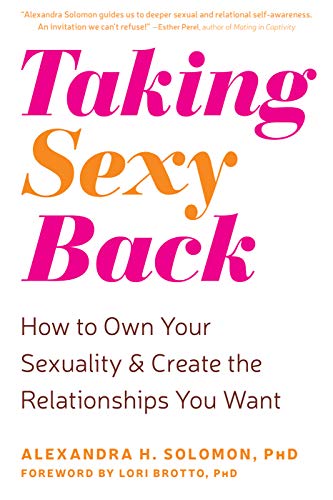
Taking Sexy Back
Alexandra Solomon's guide to owning your sexuality and building relationships from a place of self-knowledge. Practical, psychology-grounded, and unusually direct about what gets in the way of good sex.
Buy on Amazon → Affiliate link — we may earn a commissionSection 03Limitations and Drawbacks
The book assumes readers are in committed relationships and focuses heavily on heterosexual partnerships. Single readers or those in non-traditional relationship structures may find limited applicable content. The emphasis on long-term partnership building doesn't address the needs of people exploring their sexuality outside committed relationships.
Solomon's approach requires significant emotional work and self-reflection. Readers dealing with trauma or severe relationship issues may need professional support beyond what the book provides. The exercises can feel overwhelming if you're already struggling with basic psychology/sexual-communication-research/" class="contextual-link">communication or safety in your relationship.
Section 04How It Compares to Other Relationship Books
Unlike books focused purely on sexual technique, Taking Sexy Back Alexandra Solomon review reveals an approach that addresses the emotional foundation necessary for satisfying physical intimacy. It's more practical than Esther Perel's Mating in Captivity but less research-heavy than Lori Brotto's Better Sex Through Mindfulness.
Solomon strikes a middle ground between self-help accessibility and clinical depth. The book provides more structured exercises than many relationship guides while avoiding overly academic language that can make concepts feel distant from real-life application.
Section 05Who Should Read This Book
This Taking Sexy Back Alexandra Solomon review suggests the book works best for people in established relationships who recognize their own patterns getting in the way of deeper intimacy. If you find yourself having the same arguments or feeling disconnected despite loving your partner, Solomon's framework offers concrete tools for change.
The book particularly benefits readers who intellectually understand relationship concepts but struggle with emotional regulation in the moment. Solomon's focus on self-awareness before partner-focused change makes this ideal for people who tend to blame their partner rather than examining their own contributions to relationship dynamics.
When Professional Help Matters
If you experience ongoing emotional or physical safety concerns, addiction issues, or trauma responses that feel overwhelming, seek qualified couples therapy or individual counseling before relying solely on self-help approaches.
Step-by-stepPractical Instructions
Identify your relational triggers
Notice moments when you feel suddenly defensive, withdrawn, or critical of your partner. Keep a simple log for one week, noting the situation, your emotional reaction, and any physical sensations. Look for patterns - do certain topics, times of day, or partner behaviors consistently trigger similar responses in you?
Practice the pause technique
When you notice a trigger activating, take three deep breaths before responding. Ask yourself: "What am I feeling right now?" and "What do I actually need?" This creates space between stimulus and response, preventing reactive patterns that damage intimacy and connection.
Express needs without blame
Use Solomon's formula: "I notice I feel [emotion] when [specific situation]. What I need is [concrete request]." For example: "I notice I feel disconnected when we don't talk during dinner. What I need is for us to put phones away and check in with each other."
Create emotional safety rituals
Establish small daily practices that build connection and trust. This might be five minutes of undivided attention when you reunite after work, or a weekly check-in about relationship satisfaction. Consistency matters more than duration - small, regular gestures build intimacy more effectively than grand occasional efforts.
Address sexual needs directly
Apply emotional awareness to physical intimacy by naming what you want and need. Instead of hoping your partner will guess, use specific language: "I love when you touch me slowly at first" or "I need more time to get aroused when I've had a stressful day."
Avoid theseCommon Mistakes
Focusing only on partner's issues
You miss your own contribution to relationship patterns and maintain victim mindset
Trying to change everything immediately
Overwhelming yourself leads to abandoning the work when it feels too difficult
Using techniques as weapons
Relationship tools become manipulation when used to prove you're right
Expecting instant results
Relational patterns took years to develop and require patience to change
"Self-awareness without self-compassion becomes another form of self-criticism that ultimately blocks the vulnerability necessary for intimate connection."
On the importance of gentle self-reflection in relationship work
FAQFrequently Asked Questions
Further ReadingRecommended Books
- Mating in Captivity — Esther Perel Desire, intimacy, and connection
- Attached — Amir Levine Attachment theory and relationships
Links are affiliate links. We may earn a commission at no extra cost to you.
SourcesPeer-reviewed references
- Solomon, Alexandra H (2020) Taking Sexy Back: How to Own Your Sexuality and Create the Relationships You Want. New Harbinger Publications.
- Gottman, John M. & Levenson, Robert W (2000) The timing of divorce: predicting when a couple will divorce over a 14-year period. Journal of Marriage and Family. doi:10.1111/j.1741-3737.2000.00737.x
- Perel, Esther (2006) Mating in Captivity: Unlocking Erotic Intelligence. Harper.
- Brotto, Lori A (2018) Better Sex Through Mindfulness: How Women Can Cultivate Desire. Greystone Books.
Every DOI above resolves via CrossRef. Figures quoted in this article are drawn from these papers or stated in qualified terms.
