
Most couples think closeness automatically creates desire, but psychotherapist Esther Perel argues the opposite.
You love your partner deeply, yet feel like roommates who rarely connect sexually anymore.
Section 01The Central Paradox of Modern Love
Perel's core thesis challenges everything couples believe about lasting relationships. She argues that the very qualities that create emotional security—predictability, familiarity, and constant togetherness—can slowly erode sexual desire. This creates what she calls the 'fundamental dilemma' of committed relationships.
The book draws from Perel's twenty years of couples therapy, presenting case studies of real partners struggling with this exact tension. Rather than offering quick fixes, she reframes the problem entirely. Your decreased passion isn't a relationship failure—it's a natural result of how modern couples structure intimacy.
Why Safety Kills Desire
Perel explains that desire requires psychological space, mystery, and even mild uncertainty. When you know everything about your partner's daily routine, thoughts, and habits, the unknown element that fueled early attraction disappears. This mating in captivity review found this insight particularly valuable for long-term couples.
Section 02Practical Solutions That Actually Work
Unlike relationship books that stay theoretical, Mating in Captivity provides specific techniques couples can use immediately. Perel introduces concepts like 'cultivated distance' and 'erotic privacy' that help partners maintain individual mystery while staying emotionally connected.
The book's strength lies in normalizing the desire struggle. Perel validates that wanting space doesn't mean you love your partner less, and that sexual fantasy involving others is healthy. She provides scripts for difficult conversations and concrete exercises to rebuild attraction.
The Role Play Revolution
One technique that stands out in this mating in captivity review involves structured role-playing where couples temporarily adopt different personas. This isn't about costumes or elaborate scenarios—it's about creating psychological distance that allows desire to resurface.
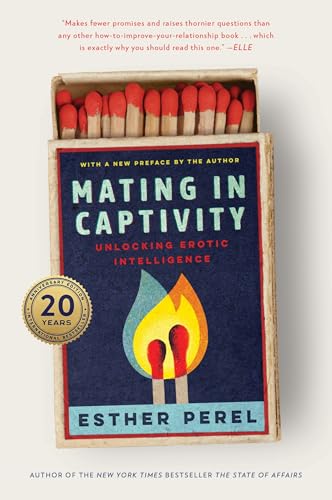
Mating in Captivity
Esther Perel asks why desire so often disappears in committed relationships — and how to get it back. Required reading for any long-term couple.
Buy on Amazon → Affiliate link — we may earn a commissionSection 03Cultural Wisdom Meets Modern Relationships
Perel's multicultural background enriches every chapter. She contrasts American relationship expectations with European attitudes toward sexuality, showing how cultural assumptions about monogamy and intimacy vary dramatically across societies.
This global perspective helps readers understand that their relationship challenges aren't personal failures but products of specific cultural messaging. The book examines how different societies balance commitment with desire, offering alternative models for modern couples to consider.
Section 04What This Book Gets Wrong
While insightful, Mating in Captivity assumes couples have already mastered basic psychology/sexual-communication-research/" class="contextual-link">communication and intimacy skills. Partners struggling with fundamental trust issues or severe sexual dysfunction may find Perel's advice premature for their situation.
The book also focuses heavily on psychological aspects of desire while giving less attention to physical factors like hormones, medications, or health conditions that impact libido. Couples dealing with medical causes of low desire need additional resources beyond what this mating in captivity review covers.
Section 05Who Should Read This Book
Mating in Captivity works best for couples in stable relationships where passion has diminished over time. If you've been together for several years and feel more like best friends than lovers, Perel's framework will resonate deeply.
The book particularly helps partners who feel guilty about wanting space or fantasy. Perel's permission-giving approach normalizes these desires and provides tools to discuss them openly without threatening relationship security.
Respect Individual Boundaries
Not every couple needs or wants the same level of space or fantasy sharing. Customize Perel's advice to match your specific relationship dynamics and comfort levels.
Step-by-stepPractical Instructions
Create deliberate distance
Spend time apart pursuing individual interests without constant check-ins. This isn't about creating problems—it's about maintaining the mystery that fuels desire. Take evening classes, visit friends alone, or travel separately occasionally.
Stop sharing every thought
Maintain some emotional privacy by keeping certain experiences, fantasies, or daily details to yourself. Complete transparency can eliminate the intrigue that makes your partner curious about you.
Schedule anticipation periods
Plan intimate encounters in advance, then spend the intervening time building anticipation through subtle touches, texts, or shared glances. The waiting period can be as arousing as the actual encounter.
Practice seeing your partner differently
Watch your partner interact with others in social settings. Notice qualities you've forgotten or behaviors you don't see at home. This outside perspective can revive your appreciation for who they are beyond their role in your daily routine.
Discuss fantasy boundaries
Use Perel's framework to talk about sexual fantasies without threatening your relationship. Establish what you're comfortable sharing and what remains private. This conversation itself can rebuild intimacy.
Avoid theseCommon Mistakes
Expecting immediate passion recovery
Rebuilding desire takes months of consistent effort, not weeks
Creating distance through conflict
Negative space doesn't build desire, it builds resentment
Sharing all fantasies immediately
Too much disclosure too fast can overwhelm your partner
Ignoring your partner's comfort level
Pushing boundaries too hard can damage trust and intimacy
"Love enjoys knowing everything about you; desire needs mystery. Love likes to shrink the distance between partners; desire benefits from space."
Explaining the fundamental tension between security and passion
FAQFrequently Asked Questions
Further ReadingRecommended Books
- Mating in Captivity — Esther Perel Desire in long-term relationships
- The New Male Sexuality — Bernie Zilbergeld Intimacy and connection
Links are affiliate links. We may earn a commission at no extra cost to you.
SourcesPeer-reviewed references
- Perel, E (2006) Mating in Captivity: Unlocking Erotic Intelligence. Harper Paperbacks.
- Meston, C. M., & Buss, D. M (2007) Why humans have sex. Archives of Sexual Behavior. doi:10.1007/s10508-007-9175-2
- Sprecher, S (2002) Sexual satisfaction in premarital relationships: Associations with satisfaction, love, commitment, and stability. Journal of Sex Research. doi:10.1080/00224490209552161
- Gottman, J. M., & Levenson, R. W (2000) The timing of divorce: Predicting when a couple will divorce over a 14-year period. Journal of Marriage and Family. doi:10.1111/j.1741-3737.2000.00737.x
Every DOI above resolves via CrossRef. Figures quoted in this article are drawn from these papers or stated in qualified terms.
