
Come As You Are claims to revolutionize your sex life through science, but does Emily Nagoski deliver on this bold promise?
You're tired of generic sex advice that ignores individual differences and doesn't address your specific pleasure challenges.
Section 01The Science Behind the Hype
Emily Nagoski built her Come As You Are framework around dual control theory - the idea that sexual arousal involves both accelerators and brakes. Your sexual response depends on activating turn-ons while deactivating turn-offs. This concept alone makes the book worth reading.
Nagoski backs her claims with legitimate research from Masters and Johnson, Kinsey, and contemporary sexologists. She cites over 300 studies throughout the book. The science checks out, though she sometimes oversimplifies complex neurological processes for general audiences.
Section 02Strengths That Set It Apart
The book excels at normalizing different arousal patterns. Nagoski destroys the myth of 'normal' sexual response by explaining responsive vs. spontaneous desire. If you've ever felt broken because you don't get randomly horny, this section will change your perspective completely.
Her stress chapter connects cortisol levels to sexual function with practical solutions. She explains why your busy mind kills arousal and provides concrete techniques to shift into pleasure mode. The 'complete the cycle' concept for processing stress gives you actionable tools for better sex.
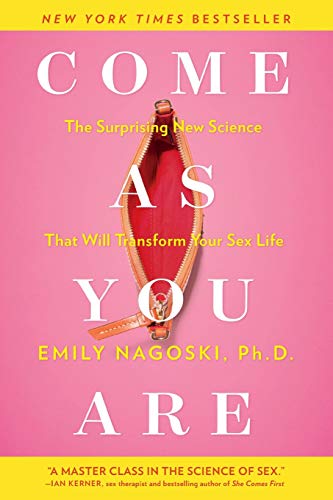
Come As You Are
The most research-backed book on female sexuality available. Nagoski explains why your body works the way it does — and why 'normal' is a much bigger category than you think.
Buy on Amazon → Affiliate link — we may earn a commissionSection 03Where the Book Falls Short
Come As You Are focuses heavily on female sexuality while claiming universal applicability. Male readers will find limited discussion of stamina, technique, or male-specific arousal patterns. The book assumes a primarily female audience despite marketing itself as comprehensive.
Nagoski's writing style can feel preachy at times. She repeats key messages excessively and uses excessive metaphors that slow down practical application. You'll spend significant time reading around the actionable content rather than diving straight into techniques.
Section 04Practical Applications for Better Sex
The mindfulness exercises actually work for increasing sensation and focus. Nagoski's body awareness techniques help you identify your personal arousal triggers and blocks. She provides specific meditation practices designed for sexual enhancement rather than generic mindfulness.
Her communication framework gives you scripts for discussing desires and boundaries. The book includes worksheets for mapping your sexual accelerators and brakes with your partner. These tools translate scientific concepts into bedroom improvements you can implement tonight.
Section 05Who Should Read This Book
Come As You Are works best for people struggling with responsive desire or stress-related sexual difficulties. If you need mental permission to want sex differently than societal expectations, Nagoski provides that validation with scientific backing. Couples dealing with mismatched libidos will find the desire chapters particularly helpful.
Skip this book if you're looking for specific physical techniques, positions, or performance enhancement. Nagoski focuses on psychological and emotional aspects of sexuality rather than mechanical skills. Men seeking stamina or technique advice should look elsewhere for more targeted guidance.
Consent and Communication
Nagoski's communication exercises require mutual willingness to share vulnerabilities. Never pressure your partner to complete worksheets or disclose triggers they're not ready to discuss. Sexual healing happens at each person's individual pace.
Step-by-stepPractical Instructions
Identify Your Accelerators and Brakes
List everything that turns you on (accelerators) and everything that kills your mood (brakes). Include physical sensations, emotional states, environmental factors, and relationship dynamics. Be specific - 'feeling appreciated' is better than 'good relationship.' Use Nagoski's worksheets or create your own detailed inventory.
Practice Stress Completion Cycles
When you feel stressed, engage in 20 minutes of physical movement to complete your body's stress response. This could be vigorous exercise, dancing, or even shaking your limbs. Follow with 10 minutes of deep breathing or meditation. This clears cortisol from your system and prepares your nervous system for arousal.
Map Your Arousal Context
Notice when you feel most sexually responsive. Track time of day, stress levels, relationship dynamics, and physical environment. Nagoski emphasizes that context matters more than libido. Create optimal conditions by controlling variables you can influence - lighting, temperature, privacy, and emotional connection.
Implement Mindful Body Scanning
During intimate moments, spend 5-10 minutes focusing solely on physical sensations without judgment. Start at your head and slowly move attention through each body part. Notice tension, warmth, tingling, or numbness. This builds body awareness and helps you stay present instead of mentally checking out.
Communicate Using Nagoski's Framework
Share your accelerators and brakes list with your partner. Use her suggested language: 'I notice I feel more aroused when...' and 'I lose arousal when...' Focus on your internal experience rather than their behavior. Schedule regular check-ins to update each other on changing preferences and triggers.
Avoid theseCommon Mistakes
Expecting instant arousal changes
Nagoski's techniques require consistent practice over weeks to rewire stress responses and arousal patterns.
Skipping the stress management chapters
High cortisol levels block arousal regardless of physical technique or desire levels.
Using the book as technique manual
Come As You Are focuses on psychology and context rather than physical methods.
Applying concepts without personal adaptation
Nagoski emphasizes individual differences - her exact methods won't work for everyone.
"The most important sexual organ is the brain, and understanding your unique arousal patterns matters more than following generic advice."
Reviewing evidence-based approaches to sexual wellness
FAQFrequently Asked Questions
Further ReadingRecommended Books
- The Science of Orgasm — Barry Komisaruk Neuroscience of pleasure
- Come As You Are — Emily Nagoski Research-backed sexuality
Links are affiliate links. We may earn a commission at no extra cost to you.
SourcesPeer-reviewed references
- Nagoski, E (2015) Come As You Are: The Surprising New Science That Will Transform Your Sex Life. Simon & Schuster.
- Bancroft, J., & Janssen, E (2000) The dual control model of male sexual response: A theoretical approach to centrally mediated erectile dysfunction. Neuroscience & Biobehavioral Reviews. doi:10.1016/S0149-7634(00)00024-5
- Diamond, L. M., & Huebner, D. M (2012) Is good sex good for you? Rethinking sexuality and health. Social and Personality Psychology Compass. doi:10.1111/j.1751-9004.2012.00429.x
- Meston, C. M., & Buss, D. M (2007) Why humans have sex. Archives of Sexual Behavior. doi:10.1007/s10508-007-9175-2
Every DOI above resolves via CrossRef. Figures quoted in this article are drawn from these papers or stated in qualified terms.
