
Deep penetration isn't just about going harder—it's about finding the right angles for maximum sensation.
You want more intense physical connection, but standard positions leave you feeling like something's missing.
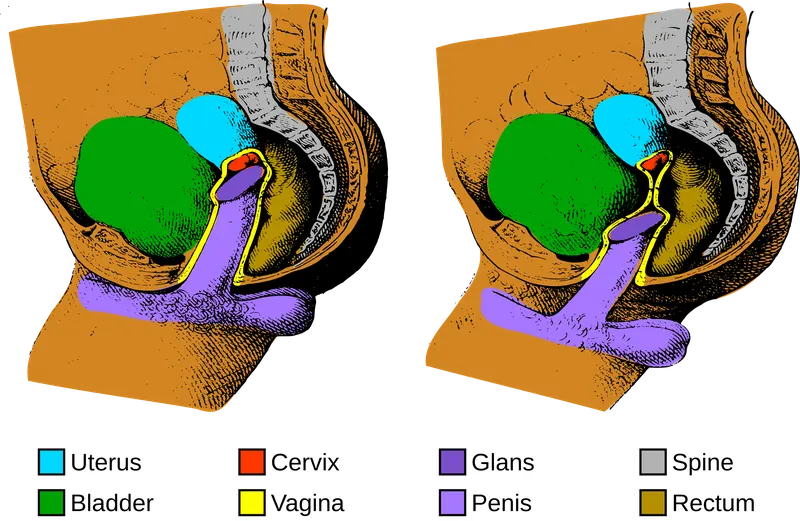
Section 01Why Anatomy Matters More Than Effort
Your partner's vaginal canal typically measures 3-6 inches when aroused, but it lengthens and widens during high arousal. This means timing and arousal level affect how deep penetration feels more than the position itself.
The cervix sits at different heights depending on where your partner is in her menstrual cycle. During ovulation, it rises higher, creating more space. Right before menstruation, it sits lower, making some deep penetration positions uncomfortable.
The Angle Advantage
Deep penetration positions work by changing the angle of entry to match your partner's natural anatomy. The vaginal canal curves slightly upward, so positions that mirror this curve feel more intense and comfortable than straight-line thrusting.
Section 02Foundation Positions That Create Depth
Start with these three base positions before moving to advanced variations. Each one changes the pelvic angle to allow deeper entry while maintaining comfort and intimacy.
Modified missionary involves your partner pulling her knees toward her chest while you support yourself on your forearms. This tilts her pelvis and shortens the distance to penetration. Sarah and Mike discovered this position eliminated the shallow thrusting that left them both frustrated.
The Leapfrog position builds directly on standard doggy style by having the receiving partner lower their chest to the mattress while keeping their hips elevated. This chest-down adjustment rotates the pelvis in a way that straightens the vaginal canal and shortens the distance the penetrating partner needs to travel to reach full depth. Placing a pillow under the receiving partner's hips sustains that angle without requiring constant muscular effort, freeing both partners to focus on rhythm and pressure rather than position maintenance.
The Deep Spoon Technique
Spooning becomes a deep penetration position when your partner arches her back and you adjust your hip placement. Enter from a higher angle, with your hips positioned above hers rather than directly behind.
Section 03Advanced Positioning for Maximum Depth
These positions require more flexibility and psychology/sexual-communication-research/" class="contextual-link">communication but offer the deepest penetration possible. Start slowly and check in frequently—deep doesn't mean rough.
The prone bone position has your partner lying face-down while you enter from above. This creates an incredibly tight fit and allows very deep penetration, but requires careful attention to your partner's comfort signals.
Standing and Elevated Options
Counter-height surfaces create natural deep penetration positions. Your partner stands and bends forward while you enter from behind. The height difference and angle allow for deeper entry than bed-based positions.
Section 04Comfort Modifications for Every Body
Not every deep penetration position works for every couple. Hip flexibility, height differences, and individual anatomy all affect what feels good. These modifications help you adapt positions to your bodies.
Pillow placement changes everything in deep penetration positions. A pillow under your partner's hips in variations/" class="contextual-link">missionary-style positions tilts her pelvis for easier deep entry. Multiple pillows can create the exact angle that works for your body combination.
Section 05Communication During Deep Penetration
Deep penetration requires more ongoing psychology/sexual-communication-research/" class="contextual-link">communication than other sexual activities. Your partner needs to guide depth, speed, and angle adjustments in real-time.
Create simple signals for 'deeper,' 'slower,' and 'perfect.' Hand placement, verbal cues, or body positioning can communicate without interrupting the flow. Practice these signals during less intense moments so they feel natural when you need them.
Section 06Deep Penetration Positions for Conception
When the goal is conception, positions that place the penetrating partner behind or above the receiver tend to deposit semen closest to the cervix. variations/" class="contextual-link">Missionary with the receiver's hips elevated on a pillow is a reliable choice because gravity assists pooling near the cervical os immediately after ejaculation. The Anvil — receiver on their back with legs folded toward their chest — achieves similar proximity and requires no props beyond a flat surface.
After penetration ends, the receiving partner lying still on their back with hips slightly raised for several minutes may help. No position guarantees conception, but minimizing the distance between semen and cervix removes one mechanical variable. Avoid positions where the receiver is upright immediately afterward, as this works against the natural cervical angle.
Pain vs. Pressure
Deep penetration should create a feeling of fullness or intense pressure, never sharp pain. Sharp pain, especially near the cervix, means you need to adjust angle or reduce depth immediately. Always stop if your partner experiences pain.
Lubrication Matters More
Deep penetration positions require more lubrication than shallow positions. Have quality lubricant within reach and reapply as needed. Natural lubrication decreases over time even during continued arousal.
Step-by-stepPractical Instructions
Begin with extended foreplay
Spend at least 15-20 minutes on arousal before attempting deep penetration positions. Full arousal lengthens the vaginal canal and increases natural lubrication, making deeper entry comfortable rather than painful. Focus on external stimulation and gradually work toward internal stimulation.
Start in familiar territory
Begin in your usual comfortable position, then gradually adjust angles for deeper penetration. This lets you both feel the difference as you modify positioning. Make small changes—lifting hips slightly, adjusting leg placement, or changing your supporting position.
Use pillows strategically
Place a firm pillow under your partner's hips in missionary-style positions, or behind her back in seated positions. This changes the pelvic angle to align with the natural curve of the vaginal canal. Experiment with pillow height and firmness to find your optimal angle.
Control depth with hand placement
Your partner can place her hands on your hips or chest to control how deep you go. This gives her immediate control over depth and prevents overly forceful thrusting. You can also use your own hands against the bed or wall to control your movement.
Adjust speed for sensation
Deep penetration positions work best with slower, more deliberate movement. Fast thrusting reduces the sensation of depth and can cause discomfort. Focus on the withdrawal as much as the thrust—the contrast creates the feeling of depth.
Check in without stopping
Ask 'How does this feel?' or 'Deeper?' while maintaining physical connection. Your partner's breathing, muscle tension, and vocal responses tell you whether to continue or adjust. Learn to read these signals so verbal check-ins become less necessary over time.
Avoid theseCommon Mistakes
Rushing into deep positions
Insufficient arousal makes deep penetration uncomfortable and potentially painful
Assuming deeper means better
Maximum depth isn't always maximum pleasure for either partner
Using force instead of angles
Pushing harder without changing position causes discomfort, not deeper penetration
Staying in uncomfortable positions
Muscle strain or joint discomfort kills arousal and sensation
Ignoring her cycle timing
Cervix height changes throughout the menstrual cycle affect comfort
"The key to successful deep penetration is matching the natural anatomy rather than working against it through positioning and angles."
Based on anatomical research and reader feedback
FAQFrequently Asked Questions
Further ReadingRecommended Books
- Mating in Captivity — Esther Perel Desire in long-term relationships
- The New Male Sexuality — Bernie Zilbergeld Intimacy and connection
Links are affiliate links. We may earn a commission at no extra cost to you.
SourcesPeer-reviewed references
- Meston, C. M., & Buss, D. M (2007) Why humans have sex. Archives of Sexual Behavior. doi:10.1007/s10508-007-9175-2
- Komisaruk, B. R., & Whipple, B (2011) Non-genital orgasms. Sexual and Relationship Therapy. doi:10.1080/14681994.2011.649252
- Lloyd, E. A (2005) The Case of the Female Orgasm: Bias in the Science of Evolution. Harvard University Press.
Every DOI above resolves via CrossRef. Figures quoted in this article are drawn from these papers or stated in qualified terms.
